Monday, June 8, 2015

June 8: Saints Severinus and Victorinus

History

Saints Severinus and Victorinus were brothers, born to a wealthy family. Because they loved Jesus so much, they gave away all their wealth and became hermits, people who live apart from everybody else so they can focus on prayer. Victorinus often struggled with temptation – sometimes he even had himself tied to a tree so that he wouldn’t give in. 

Activity

In a family, it’s important that we help each other live holy lives, just as Saints Severinus and Victorinus did. It may not be a very good idea to tie each other to trees, though, is it? Instead, use some colored yarn or embroidery floss to make bracelets for each other. Together, pray over the bracelets, and ask God to help you remember to do the right thing every time you see the bracelet on your wrists. 

Instructions


More reading for parents:

Sunday, June 7, 2015

June 7: Feast of Corpus Christi

History

In 1246, a humble religious sister in Belgium - Saint Juliana of Mont Carillon - received inspiration form the Lord to start a celebration of the Blessed Sacrament. She convinced Bishop Robert de Thorte of Liege, and he started the Feast of Corpus Christi on the first Sunday after the feast of the Trinity. He knew that this feast would help renew the faith of Christians, and improve their attitude about the Blessed Sacrament. Ever since, Catholics around the world have celebrated the feast of Corpus Christi with Eucharistic Processions held in streets and neighborhoods, which has led to many people converting to the Catholic faith. 

Activity

A Corpus Christi procession in Spain
Photo by Ramon F Velasquez
Find a Corpus Christi procession in your area and bring your whole family. (If you've never been in one before, don't worry - it's easy to follow along with the hymns and prayers.) It's traditional for the people in the procession to carry flowers and for children who have made their First Holy Communion recently to wear their sacramental clothing. Then enjoy a special meal with your family. 

More reading for parents:


Last year, we learned about St. Willibald and watched short videos about the Holy Land. 

Saturday, June 6, 2015

June 6: St. Norbert

St. Norbert

History

Norbert was sort of a spoiled child who always got everything he wanted and never had to lift a finger. As a young man, he was riding his horse in his elegant clothes when a sudden thunderstorm sprang up. His horse got scared and Norbert fell off, which knocked him unconscious. When he woke up, he was wet, muddy, achy and ready to follow Jesus. He became a priest. When people doubted his sincerity, he gave away everything he owned and went around the country barefoot, preaching about Jesus. After he was made bishop of Magdebourg, he went to move into the bishop’s residence, but the doorman wouldn’t let him in because he looked like a beggar – that’s how much Norbert had changed! 

Activity

If you live in the U.S., you probably have quite a few possessions to call your own. Is there any one item that makes you feel particularly vain or overly proud of yourself? An article of clothing? An electronic device? Today, follow St. Norbert’s example and get rid of that object. Of course, some of us do not have that kind of pride in things, so if you can’t think of something to give away, simply ask Saint Norbert to pray that you never do. 

Saint Norbert, pray for us!

More reading for parents: 


Friday, June 5, 2015

June 5: St. Boniface of Mainz

History

St. Boniface of Mainz had a lot of trouble when he first tried to be a missionary, but he soon figured out that his problem was trying to do everything on his own instead of asking for help. At the time, most of Europe was pagan – people worshiped idols or even trees. Saint Boniface had to be very patient, trusting God and getting help from other missionaries. They were able to convince many people to become Christians. When St. Boniface was an old man, some people attacked him and his helpers, and he held up a Bible as his only shield. The attacker shoved his sword through the Bible, and that's why statues and paintings of St. Boniface of Mainz show him holding a book with a sword in it.


Activity

Think about something that’s hard to do all by yourself. You can either keep trying to do it alone and failing, or you can ask for help or you can just give up. Which is the best way to handle it? Now think of something that you accomplished after trying very hard for a long time, like learning to ride a bike or learning to play a song on the piano. Were you mostly patient or mostly impatient during the process? Ask Saint Boniface of Mainz to pray for everybody in your family, that you will all be patient and ask for help when you need it. 

Saint Boniface of Mainz, pray for us!


More reading for parents:

Thursday, June 4, 2015

June 4: St. Francis Caracciolo

St. Francis Caracciolo

History

Saint Francis Caracciolo was born in Naples, Italy. When he was young, he came down with a terrible skin disease, but he was miraculously cured when he vowed to devote himself to God. So, he became a priest. Once, somebody wrote a letter to another Father Caracciolo about starting a new religious order, but it was delivered to Saint Francis Caracciolo by mistake. Saint Francis decided it was God’s will that he had received the letter instead of the other priest and agreed to help. Even after he was made the order’s leader, he continued to wash dishes, sweeping and so on, just like all the other brothers. He is the patron saint of Italian cooks.

Activity

Help your family by doing an extra chore today, just like Saint Francis, such as sweeping or washing dishes. Then, help prepare a delicious Naples-style meal for supper (or have pizza - the original "fast food" of Naples).

Salsicce al Pomodoro

Prep time: 20 minutes
Cooking time: 45-50 minutes

(Serves 4)

  • 12-16 oz. ziti (or another pasta that you like, such as penne)
  • 1 to 1 1/2 pounds mild Italian link sausage, divided into individual links
  • 1 tablespoon extra-virgin olive oil
  • 1 28-ounce can Italian-style crushed tomatoes
  • (Optional) Pinch of hot red pepper flakes
  • Grated Romano or Parmesan cheese.
  • Roasted Broccoli (recipe follows, or replace with another green side dish)
  • (Optional) Italian bread

  • 1. Have one of the children prick the links several times with a fork. Heat oil in a deep 10-inch skillet or sauté pan over medium heat. Arrange the sausage in the shimmering oil so that they are not touching. Brown the sausages lightly all over. This takes about 10 minutes, adjusting the heat as necessary so neither the fat nor the brown bits in the pan burn. Pour or spoon off all the fat in the pan but keep the brown bits.

    2. Pour the can of tomatoes directly into the pan with the sausage. Season with hot pepper flakes, if you like. (You won't need salt.) Turn the heat to low and simmer for 30 to 35 minutes, until the sausages are cooked through and the sauce has thickened.

    3. Meanwhile, boil and drain the pasta according to package directions. Serve each person sausage, a little mound of pasta topped with the sauce and grated cheese, and a green side dish like Roasted Broccoli. 


    Roasted Broccoli

    (Serves 4)

  • 1 head of broccoli, washed and cut into bite-sized pieces. 
  • 1/4 cup olive oil
  • Salt and pepper
  • 1 lemon
  • 1/2 cup grated Romano or Parmesan cheese

    1. Heat your oven to 425°. Prepare a large sheet pan (with sides, like a jelly-roll pan) with foil. 

    2. Toss the broccoli with olive oil. Spread in a single layer in the pan and sprinkle with salt and pepper.

    3. Roast for 20 minutes, stirring with a wooden spoon at the 10- and 15-minute marks. When the broccoli is nicely roasted with a few spots of brown here and there, pull it out of the oven and immediately squeeze the lemon over all, followed by the grated cheese. 

    Saint Francis Caracciolo, pray for us!

  • More reading for parents:

    Wednesday, June 3, 2015

    June 3: Saint Charles Lwanga and companions

    "St. Charles Lwanga
    and His Followers"
    by Albert Wider

    History

    In 1879, the Society of Missionaries of Africa went to Uganda to tell people about Jesus. Six years later, there were many converts who helped spread the Gospel. But King Mwanga was a cruel man who killed a Protestant missionary team and the leader of the Catholic believers. When Charles Lwanga was leading the Christian community at court, King Mwanga condemned all the Christians at court to die. Charles Lwanga quickly baptized four of the young men who wanted to become Christians. Together, they and many others were marched 37 miles to a place of execution, but Charles and the others were full of joy because they were dying for Christ, their Savior. 

    Activity

    These brave Ugandan Christians were burned to death, but as they died, they called on the name of Jesus and told their executioners, “You can burn our bodies, but you cannot harm our souls.” King Mwanga didn’t understand that people are more than just their bodies. Today, make ice cube candles. The holes in the wax represent a person’s soul that cannot be burned. Here’s a four-minute video on YouTube that shows how to make this easy craft. 

    Saint Charles Lwanga, pray for us! 

    More reading for parents:

    Catholic News Agency
    Catholic Online

    In 2013, we celebrated St. John Grande on June 1 and wrote letters/cards to sick people. If you prefer that activity today, by all means, do so!

    Tuesday, June 2, 2015

    June 2: Pope Saint Eugene I

    History

    Eugene was a Roman priest who had a reputation for being generous, gentle and holy. Pope Saint Martin I was in office at the time, but the Emperor, Constans II, didn’t like him, because Martin was fighting against a heresy that Constans II thought was true. So Constans had Martin abducted from the Holy See and carried off into exile. Of course, people still needed a pope, so Constans had Eugene elected. Most people thought that this meant Pope Eugene would do whatever Constans told him to do. However, Jesus had promised that “the gates of hell will not prevail” against the Church (Mt. 16:19), and Eugene refused to follow Constans’ orders. He stayed true to Christ and taught the right things. 

    Activity

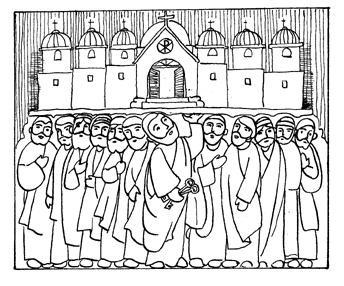
    Eugene was a holy man, devoted to Jesus, and that’s why Pope Martin I, before he died, approved of Eugene being given the papacy. Martin knew that Eugene was close to the Lord and would be a fine successor to Peter. Today, read Mt. 16:18,19 and thank God for protecting the Church from error, through every single pope we’ve ever had, even the ones put in office by people who wanted to change what the Church taught. Here’s a coloring page of Peter as the “rock” on which Jesus built His Church. 

    Pope Saint Eugene, pray for us!


    More reading for parents: